
How to Build a Daily Writing Habit That Actually Sticks
Day one you write six hundred words and feel unstoppable. Day four you open the app, stare at the cursor for ninety seconds, and open your phone instead. Day eleven you realize you haven’t written anything since the previous Tuesday, and worse, you’d stopped noticing. This is the single most common shape a writing habit takes, and it has almost nothing to do with discipline. It has to do with how the habit was built in the first place.
Why the collapse happens around week two
Motivation is a terrible foundation for a daily habit because it’s a mood, and moods are not available on a schedule. The first few days of any new habit run on enthusiasm — a fresh notebook, a new app, the appeal of being someone who writes every day. That enthusiasm has a half-life, and it’s usually somewhere around ten to fourteen days. What survives past that point isn’t the person with the most motivation. It’s the person whose habit required the least of it to execute. If showing up depends on feeling like it, you’ve built a habit that only works on your good days, and good days aren’t the ones that need a habit.
Set a bar low enough to be insulting
The fix most people reach for is a bigger goal — a thousand words a day, an hour every morning — which is exactly backwards. A goal you can fail on a tired Tuesday is a goal that will eventually get skipped on a tired Tuesday, and one skip is usually where the whole thing quietly ends. The better version is embarrassingly small: two sentences. A hundred words. Five minutes with the phone in another room. On most days you’ll write past it anyway, because starting is the actual obstacle, not continuing. On the days you don’t, you still kept the chain unbroken, and the chain is the entire point — not the word count on any single day.
Track the habit, not just the writing
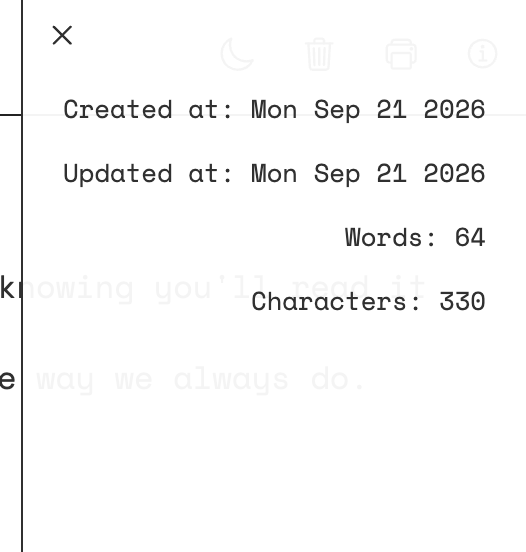
Vague intentions don’t survive contact with a Tuesday. “I’ve been writing most days” is a sentence people say right before admitting they haven’t written in a week. What holds up is something you can actually look at — a running count, a date, a number that doesn’t lie to you the way memory does. This is a smaller use for a word counter than the one it’s usually sold for: not hitting a target inside a single piece, but noticing the pattern across many of them. A note with a date stamp and a character count sitting quietly in the corner turns “did I write today” from a feeling into a fact you can check in one glance.
Protect it from your own tools
The habit dies fastest at the exact moment you sit down, in the gap between opening your laptop and actually typing. Every extra step in that gap — picking which app, deciding which folder, choosing a template — is a chance to decide you’ll do it later instead. The fix isn’t more willpower, it’s fewer steps: the same app, the same place, open to a blank page before you’ve had time to think about it. Typewriter Note was built around exactly that gap — no folder to choose, no formatting to set up, just a blank page and a word count sitting in the corner so the habit has something concrete to point at. It won’t plan your writing schedule for you, and it won’t remind you with a push notification at 7am; it just tries to make the two seconds between opening it and starting to type as short as possible.
What to do the day you miss
You will miss a day. The habit doesn’t fail there — it fails on the decision that follows, the one where a single missed day quietly becomes “well, I already broke it” and turns into a missed week. The actual rule, worth writing on a sticky note if you need to: never miss twice in a row. One skipped day is just a day. Two is the start of a new habit of not writing, and that one builds just as reliably as the one you were trying to keep. If you want the other half of this — what to do with everything you’ve actually written once the habit is working — this post covers that. If the habit is in place but your sessions keep falling apart once you sit down, the tips on staying focused while writing pick up exactly there. Otherwise, the fastest way to test any of this is to try it for five minutes and see if a lower bar changes the day you were about to skip.