Digital Journaling vs. Paper Journals: Which One Actually Sticks
Your journal from this January is probably the fourth one you’ve started in the past two years, and if it’s paper, it’s probably wedged under a stack of unopened mail with eleven entries in it. If it’s an app, it’s probably one you haven’t opened since the fourteenth, right around the day the streak notification stopped feeling like encouragement and started feeling like a small accusation. Both formats have real advocates. Both have a graveyard of abandoned attempts behind them. The honest question isn’t which one is better — it’s which one survives contact with your actual week.
What paper actually gives you
A notebook doesn’t buzz, light up, or sync. That’s not a nostalgic point, it’s a practical one: there’s no notification sitting one tap away from your journal entry, no email badge visible over the top of the page while you write. Pen on paper is also just slower than typing, and slower turns out to matter — it’s harder to write in generic, recycled phrases when your hand can’t keep up with the part of your brain that wants to skip to a tidy conclusion. A physical journal is also a genuine object. You can stack five years of them on a shelf and feel the weight of having kept the habit, which a file count never quite replicates.
The costs are just as real. A paper journal has no search, so “what was I dealing with last October” means flipping through months of handwriting hoping to recognize a date. It can be lost in a move, ruined by a spilled glass of water, or left on a train — and once it’s gone, there’s no backup. And a notebook is binary: either it’s within reach right now, or it isn’t, and most entries that don’t happen fail for exactly that reason.
What digital journaling actually gives you
An app fixes the availability problem completely — your phone is already in your pocket at 11:40pm when the thought you want to write down finally arrives, long after a notebook on the nightstand would have required getting up. Everything you write is searchable, which turns five years of entries into something you can actually use instead of just store. And nothing is a single spilled coffee away from being gone, assuming whatever you’re using actually backs up anywhere.
The failure mode here is different, and it’s rarely data loss. It’s feature creep. Open a journaling app like Day One or Journey and you’ll find mood sliders, map pins, weather snapshots, photo attachments, “on this day” surfacing — all genuinely nice, and all of it is a decision standing between you opening the app and actually writing the sentence. Pick a mood first? Tag the location? Attach today’s photo? Each one is small, but small decisions compound into the same hesitation that kills a paper habit, just rearranged into a different interface.
The format that splits the difference
The version of digital journaling that tends to actually last looks less like a dedicated journaling app and more like a plain, dated note. No mood tracker, no map, no streak counter watching you — just a blank page, today’s date, and whatever you were going to write anyway. Typewriter Note works like this by default: open it, you’re on a blank page in a fixed monospace font, nothing to configure before the first word. A tag or two if you want to separate journal entries from everything else you write there, and a running word count in the corner if you’re curious how much a bad day actually produced versus a good one.
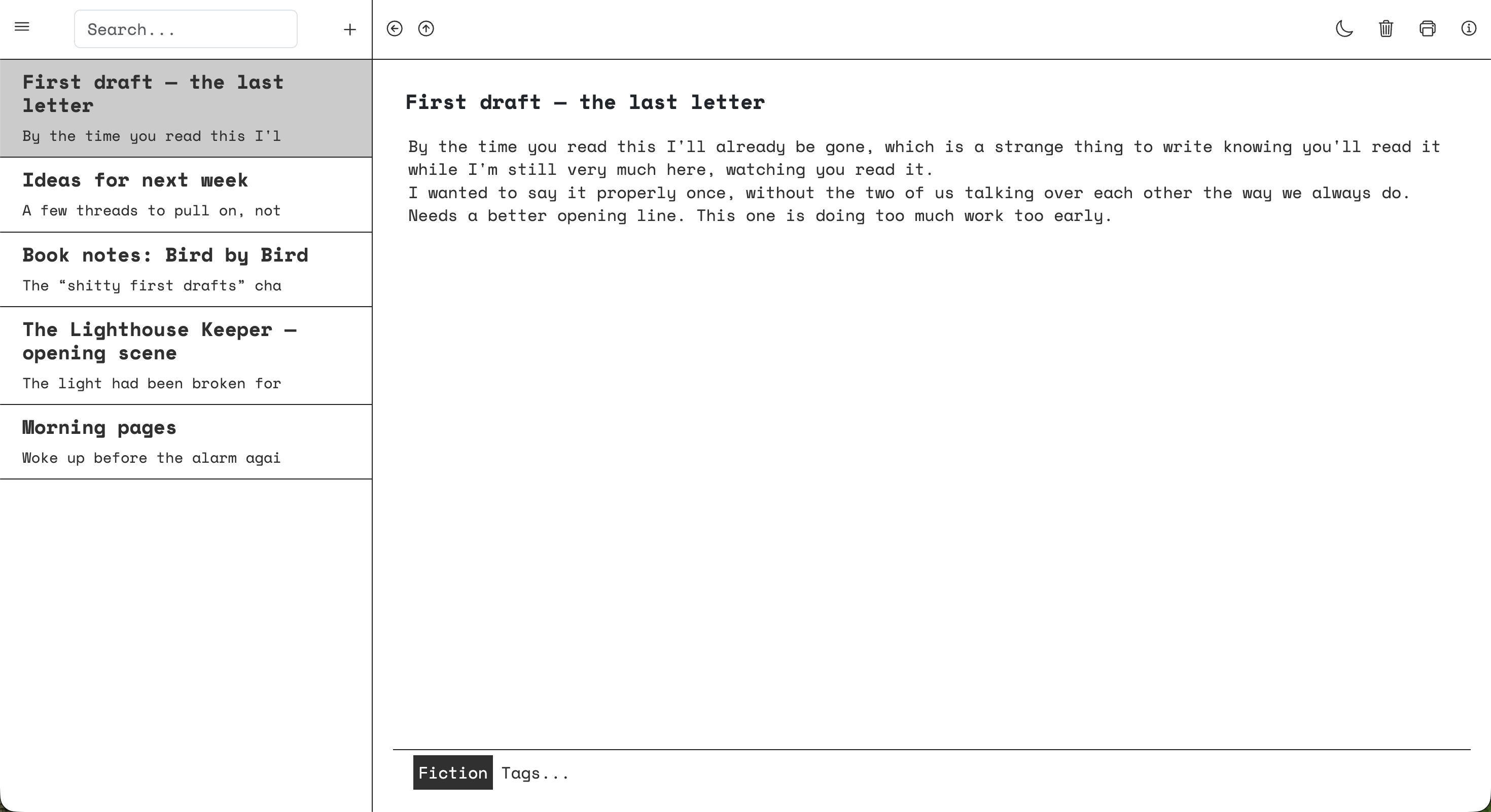
It won’t do what a dedicated journaling app does well — no mood history to look back on, no map of where you were when you wrote something, no photo attached to the memory. If that’s the part of journaling you actually care about, a purpose-built app is the better tool, full stop. What it does instead is get out of the way fast enough that opening it doesn’t become its own small decision every night.
The only real test
Neither format wins this on paper, so to speak — it comes down to which one you’ll actually reach for on a Tuesday when you’re tired and would rather not. Try two weeks of each, same time of day, same minimum (“three sentences” is plenty), and watch which one survives past day ten. If you want to test the digital side of that without committing to anything, there’s a demo with no account required. And if the habit itself is the part you keep losing, not the format, the longer piece on building a daily writing habit that actually sticks covers the part that matters more than either notebook or app.