How Many Words Should You Write a Day? A Realistic Answer
It’s 11pm, you’ve just read that Stephen King writes 2,000 words a day, every day, including his birthday, and now you’re doing math you shouldn’t be doing this late: 2,000 times 365 is 730,000 words a year, which is roughly ten novels, which means you are currently failing at something you started thinking about four minutes ago. This is a very common way to end an evening, and almost none of the math in it is useful to you.
The famous numbers were never meant for you
Stephen King writes full-time, with decades of practice turning a blank page into something that no longer costs him much hesitation. Hemingway reportedly stopped at around 500, precisely so he’d stay hungry for the next morning instead of burning out the idea. Maya Angelou rented a bare hotel room and wrote there alone until early afternoon, which tells you more about her need to escape a house full of people than about any optimal word count. These numbers get repeated like they’re settings on a machine, but they’re really just descriptions of what worked for one specific person, with one specific schedule, one specific kind of book, and — in most cases — writing as their only job. Borrowing the number without the life underneath it is how you end up discouraged by Tuesday.
Work backward from the actual finish line
A better question than “how many words should I write a day” is “how many words do I actually need, and by when.” If you’re writing a 60,000-word manuscript and you’ve given yourself six months, that’s about 330 words a day, five days a week — roughly a page. If it’s a 1,200-word essay due Friday and you’re starting Wednesday, that’s 600 words a day, which is a different kind of problem than the novel but still just arithmetic once you write it down. Most people skip this step entirely and reach straight for a round number that sounds respectable — 1,000 is the usual default — without checking whether it has anything to do with what they’re actually trying to finish, or whether it’s twice what the project needs and three times what their schedule allows.
Small and daily beats large and occasional
Here’s the part the famous-author quotes all leave out: 300 words written five days a week is 1,500 words. A single ambitious 1,500-word Saturday, chased by four empty days because Saturday wiped you out, is the same total — and far more fragile, since it depends entirely on Saturday going well. The daily version builds momentum you carry into the next session; the weekly version starts cold every single time. If you’re choosing between a daily target that feels almost too easy and a weekly one that feels appropriately serious, take the easy one. It’s the one still standing in a month.
Let the count sit quietly where you can see it, not where it can nag you
A target only works if you can check it without friction — no opening a separate spreadsheet, no doing subtraction in your head to figure out where you stand. This is one of the few genuinely useful jobs a plain running count does for you: not as a deadline bar screaming at eleven percent, just a number in the corner of the page that updates as you type and tells you the truth.
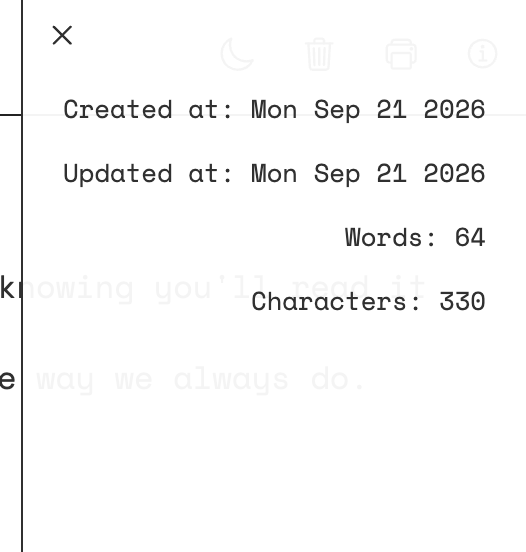
Typewriter Note keeps that count visible on every note without turning it into a progress bar you’re meant to feel bad about — on purpose. It won’t set your target for you, and it has no streaks, badges, or weekly recap email reminding you how far behind you are. It just shows the number and lets you decide what to do with it, which is honestly most of what a word count goal needs from a tool in the first place.
Pick a number smaller than the one you were about to pick
Whatever figure you land on, it should feel slightly embarrassing to tell someone — if 500 feels ambitious, start at 200. You can always write past it on a good day, and most days you will. What you’re actually building isn’t a single great writing session; it’s a habit that survives a bad one. If that part is the piece you’re still missing, the longer case for starting smaller than feels necessary covers it, or you can just open a blank page and see what 200 words actually feels like tonight.