Can You Do Morning Pages Without a Notebook?
You bought The Artist’s Way, you’re three days into the twelve weeks, and it’s 6:50am and you’re staring at a spiral notebook wondering if your hand is going to cramp before you hit page three. Julia Cameron is specific about this: morning pages are three handwritten pages, first thing, before your inner editor wakes up enough to object. No typing. No exceptions, according to the book. So the question a lot of people quietly ask around week two is whether that rule is load-bearing, or whether it’s just the format the practice happened to be invented in back in 1992.
What the exercise is actually trying to do
The point of morning pages was never the pages themselves — it’s what writing them does to the three hours after you finish. Cameron’s claim, and it holds up reasonably well in practice, is that most people are carrying around a backlog of low-grade noise: the email you’re dreading, the argument you’re replaying, the vague dread about money that hasn’t attached itself to a specific bill yet. Morning pages are a dumping ground for that noise, written fast enough and early enough that your inner critic hasn’t had its coffee yet. You’re not writing for anyone, not even future you — most people never reread their pages. The product isn’t the text. It’s the fact that the noise is now on paper instead of rattling around in your head during your 9am meeting.
Why handwriting specifically
Cameron’s reasoning is that longhand is slower than typing, and the slowness is the feature, not a limitation to engineer around. If your hand can’t keep pace with the part of your brain reaching for a clean, quotable sentence, you end up writing the actual mess instead of a tidied-up version of it. Typing is fast enough to let you draft, backspace, and reword mid-thought — exactly the editing instinct morning pages are supposed to bypass.
What changes when you type them anyway
Here’s the honest complication: plenty of people who type their morning pages report the exercise still works for them. The friction Cameron is describing can come from other places besides the pen — writing before you’re fully awake, writing somewhere with no toolbar competing for your attention, writing without stopping to fix a typo. A blank page with a fixed monospace font and nothing else on screen removes most of that editing temptation even at full typing speed. It’s not identical to longhand, but it’s a workable substitute for anyone who finds a spiral notebook genuinely less convenient than a laptop already open on the kitchen table — and for a daily practice, that might matter more than fidelity to the original method.
Measuring the thing Cameron measured in pages
Three handwritten pages in a standard notebook work out to roughly 750 words, give or take your handwriting size. That’s a useful number digitally, because “three pages” means nothing on a screen that reflows text to fit any window. Aim for 600–800 words and you’re matching the spirit of the exercise, rather than just typing until you feel like stopping — which on a bad morning might be four sentences.
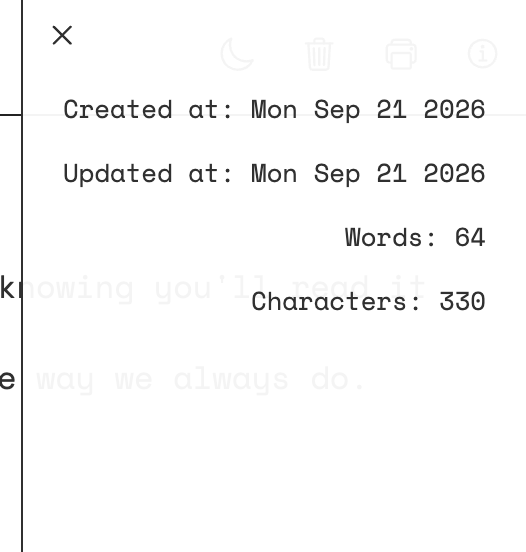
A plain running word count in the corner, with no streak badge or progress bar attached to it, is enough to tell you when you’ve hit that range without turning the exercise into a quota you’re grading yourself against. Typewriter Note keeps one visible on every note for exactly that kind of check — open a blank page, write until the number clears 700 or so, and stop. No tags required, no folder to decide on first, nothing to set up before the actual writing starts.
What you lose by not reaching for the notebook
Be honest with yourself about the trade here. A typed page doesn’t force the deceleration that’s the whole mechanism Cameron is describing, and if your pages have started reading suspiciously polished, that’s a sign the keyboard let your inner editor back in through the side door. A digital tool also can’t replicate the simple physical fact of a stack of finished notebooks on a shelf, which some people genuinely use as proof the habit is real. If either of those matters to you, buy the notebook — this isn’t a case for typing over paper, just a case that the backup option isn’t worthless.
What a digital version buys you is the one thing that kills more morning pages than any editing issue: friction at 6:50am before you’re fully conscious. If getting out a notebook and finding a pen is the actual reason you keep skipping days, a blank page that’s already open might get you writing more mornings than the “correct” version you keep not doing. And if the daily part is the harder problem than the three-pages part, the longer piece on building a habit that survives a bad week is the better next read.